What actually shifted at .NEXT—and why it matters
After spending time at Nutanix .NEXT 2026 and talking with folks like Jim Luna, Kevin Bacon, Marian, and others across the EUC community, one takeaway stood out:
EUC has moved beyond legacy VDI architectures.
Not incrementally—fundamentally.
The definition of end-user computing is expanding. We’re no longer designing just for human users, but for:
- AI agents
- Browser-based workspaces
- AI-powered applications and workflows
- Isolated browsing environments
All tied together through zero-trust access to data, not flat network-based access.
That’s a very different design point than what traditional VDI was built for.
A shift in leadership—and architecture
One of the more important (and understated) themes at .NEXT was the direction Nutanix is taking.
For years, parts of the industry have focused more on profit models than architectural innovation—creating a bit of a gap.
Nutanix is stepping into that gap.
By embracing open source and building a heterogeneous execution environment, they’re bringing together hyperscalers, hardware vendors, and ISVs—even traditional competitors—into a model that encourages interoperability and competition.
And that matters.
Because competition drives innovation—and innovation ultimately drives cost efficiency.
Why NKP is more than “Kubernetes on Nutanix”
This shift becomes more tangible when you look at NKP (Nutanix Kubernetes Platform).
NKP isn’t just Kubernetes packaged for Nutanix—it’s a CNCF-certified platform designed for:
- Portability across environments
- Interoperability between systems
- Consistency across cloud and on-prem
It brings together:
- GitOps workflows
- Centralized governance
- Integrated data services
- Support for both containers and virtual machines
But the bigger story is standardization.
CNCF is evolving into the foundation for how organizations think about not just Kubernetes—but security, AI workloads, and cloud-native infrastructure as a whole.
Security is shifting to the center
This evolution aligns closely with a broader move toward CMMC-style security models.
Traditional EUC and VDI architectures were largely built with NIST-style perimeter thinking.
What’s emerging now is different:
- Centralized policy enforcement
- Secure-by-design environments
- Protection of controlled data at the core
- Support for secure supply chains
In this model, environments are:
Secured from the center—not the edge.
And when you build this way, BYOD shifts from being a liability to an advantage—reducing both cost and operational overhead.
Performance, scale, and the role of bare metal
NKP Metal is where this model becomes operationally real.
Running Kubernetes on bare metal has always made sense—especially for edge and AI workloads where GPU density matters—but it’s traditionally been difficult to manage.
NKP Metal simplifies that.
You get:
- A unified operating model
- Built-in automation and lifecycle management
- First-class support for both containers and VMs
This directly impacts two of the biggest EUC challenges:
Scale and performance—without excessive cost.
With technologies like KubeVirt, organizations can also run VMs inside Kubernetes—allowing modernization without full refactoring.
Multi-cloud, AI, and what comes next
Nutanix is also expanding its multi-cloud approach with NC2 on AWS and Azure, running on bare-metal instances. This delivers:
- Stronger performance SLAs
- Improved availability
- Greater flexibility across environments
At the same time, Nutanix AI (NAI) is tackling a growing challenge:
Not access to AI models—but how to run and manage them efficiently.
Because AI isn’t just a model problem.
It’s an infrastructure problem.
Why this matters for Kasm Workspaces
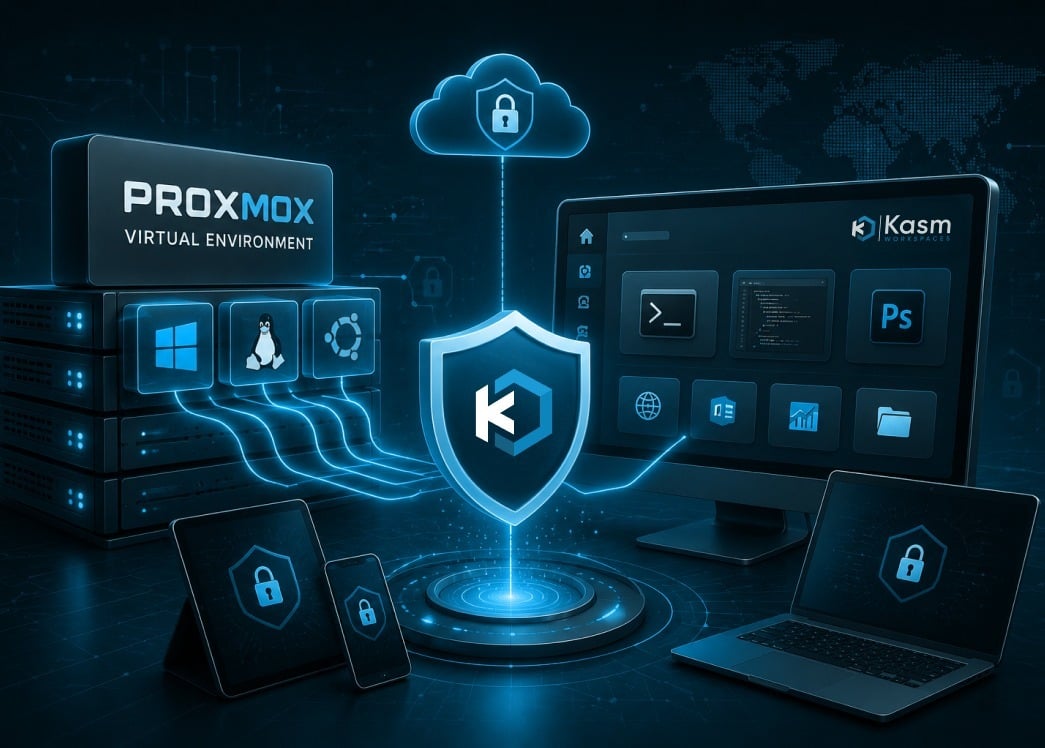
This is where the architecture shift directly connects to Kasm Workspaces.
Kasm wasn’t built to replicate legacy VDI—it was built for this emerging model.
As the first NKP-validated workspace control plane, Kasm aligns directly with where EUC architecture is heading.
Kasm enables:
- Kubernetes-based control planes
- Containerized application delivery
- Browser-based workspaces and secure browsing
- Autoscaling Windows workloads on AHV
- Deployment across hybrid and multi-cloud environments
All within a security-first architecture designed to increase cyber maturity—not compensate for gaps.
A new model for workspaces
What’s emerging now are entirely new architectural patterns:
- Isolated Browser Infrastructure (IBI)
- Secure Workspace Infrastructure (SWI)
- Enterprise Secure Browser Services
These aren’t just new terms—they reflect a shift in how work is delivered.
The workspace becomes the browser.The user can be human—or an AI agent.Policy enforcement remains consistent across both.
And again:
Everything is secured from the center.
From months to hours
One of the most impactful changes is how quickly this can now be implemented.
With Kasm available in the NKP Catalog, organizations can:
- Deploy a control plane
- Integrate AHV autoscaling
- Launch agents and workloads
- Deliver secure apps, desktops, and browsers with DLP
In hours—not months.
The cost of waiting
A theme that kept coming up in conversations at .NEXT was the cost of waiting.
Not just infrastructure cost—but the cost of staying in legacy VDI models while the rest of the ecosystem moves forward.
A gap is forming between:
- Organizations adopting CNCF-based EUC architectures
- Those maintaining traditional VDI stacks
That gap shows up in:
- Cost
- Performance
- Security posture
- Speed of execution
What comes next
If you were at Nutanix .NEXT 2026, you likely felt it.
Something shifted—not just in the technology, but in how we think about EUC, security, and infrastructure overall.
The question now is:
What are you going to build with it?
Explore how Kasm fits into your EUC strategy: https://kasm.com/solutions/platform