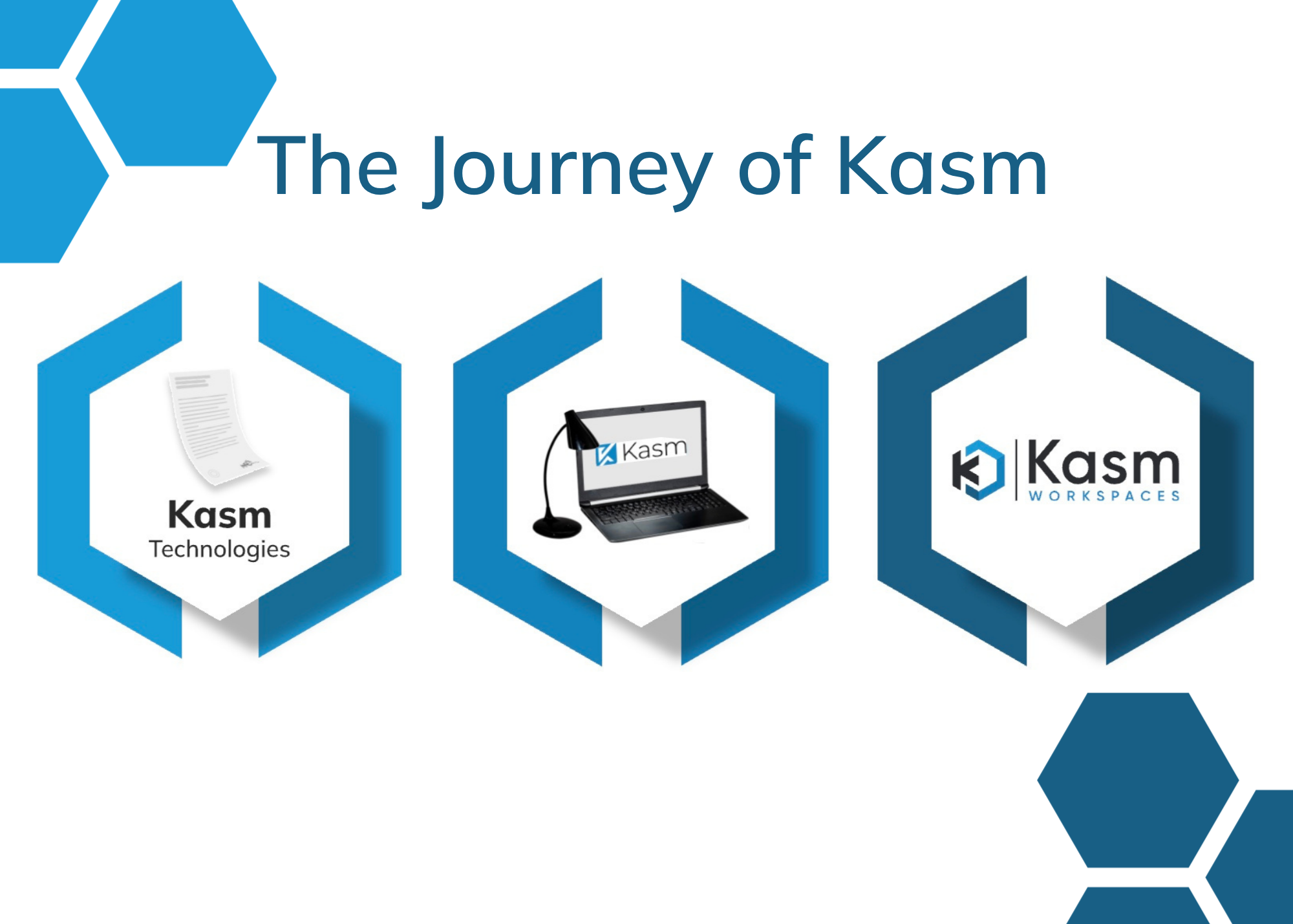
Every company has an origin story.
Some are polished. Some are exaggerated. Some take on a life of their own over time.
The story of Kasm is different. It didn’t start in a boardroom or as part of a government program. It started with a problem—one that refused to go away.
A Problem Worth Solving
Long before Kasm Technologies was founded, Justin Travis was studying cybersecurity as an undergraduate. At the time, one issue consistently ranked among the most significant threats to organizations: drive-by browser exploits.
The premise was simple. A user visits a website, their machine becomes compromised, and because that machine sits inside a trusted network, the threat spreads.
For his capstone project, Justin explored a different approach: what if users never interacted with the web directly from their local machines?
Instead, browsing would happen in a remote, isolated environment—something disposable, separate from the internal network. If it became compromised, it could simply be destroyed and replaced.
At the time, it was just a concept. There was no product, no company—just an idea.
But it stayed with him.
When Theory Meets Reality
Years later, Justin found himself working in offensive cybersecurity—researching vulnerabilities and investigating threats across some of the most dangerous corners of the internet.
The same problem resurfaced.
The tools available were limited. Analysts relied on remote machines or persistent systems that were difficult to maintain and, if compromised, carried ongoing risk.
The gap between what existed and what was needed became clear.
That early idea—remote, disposable environments for interacting with untrusted content—was no longer theoretical. It was necessary.
Reconnecting and Rebuilding
Around this time, Justin reconnected with Matt McClaskey, a longtime colleague. The two had previously worked together and had even attempted to build a company in the past, though it never fully materialized.
This time was different.
What began as a conversation quickly turned into a decision: they would build the solution themselves.
The timing aligned with the emergence of containerization technologies like Docker. Instead of relying on heavy, persistent virtual machines, they could create lightweight, ephemeral environments that spun up on demand and disappeared just as quickly.
They built an early prototype—a browser running inside a container, delivered remotely to the user.
It worked. And more importantly, people saw its potential.
The First Customer—and a Shift in Direction
Initially, the vision centered on browser isolation.
But the first real customer had a different need.
They were solving a complex access challenge: enabling multiple external organizations to securely access a controlled environment containing sensitive data.
Traditional approaches—VPNs, client installations, network tunnels—introduced operational friction and security concerns. Coordinating across different organizations and IT teams made deployment difficult, and trusting external devices created risk.
Kasm offered a different model.
No client installations. No direct network exposure. No dependency on endpoint security.
Access was delivered entirely through the browser, with strict controls around data movement and user interaction.
The customer agreed to a six-month pilot.
During that time, Justin and Matt—still working full-time jobs—built relentlessly. Nights, weekends, and any available time were spent refining the platform and delivering the features required.
At the end of the pilot, the customer converted.
They remain a customer today.
Building Before It Was a Business
For several years, Kasm existed in a transitional state.
The product was real. Customers were using it. But the company itself was still being built in the margins of full-time careers.
Justin and Matt continued developing the platform incrementally—responding to real-world use cases, refining capabilities, and learning where the product delivered the most value.
It wasn’t a traditional startup trajectory. There was no immediate scaling, no large funding rounds, and no rapid hiring.
Instead, it was methodical. Intentional. Built around real demand.
The Inflection Point
That changed in 2020.
As the world shifted toward remote work during COVID, the relevance of Kasm’s approach became more apparent. At the same time, internal momentum had reached a point where continuing part-time was no longer sustainable.
That year marked the transition to full-time focus.
It wasn’t a perfectly timed leap. It came with uncertainty, risk, and significant personal challenges. But it was necessary.
Kasm was no longer an experiment—it was a company.
Expanding Beyond the Original Vision
If Kasm had remained solely a browser isolation solution, it likely would have remained niche.
Instead, it evolved.
Customers began using the platform for more than browsing:
- Secure remote access
- Application delivery
- Linux-based workspaces
- Full desktop environments
Each new use case expanded the scope of the platform.
Over time, Kasm introduced support for full virtual desktops, including Windows environments—often driven by urgent, real-world needs from customers operating in high-stakes environments.
Some of these capabilities were developed rapidly to meet immediate demands, then refined over time into broader, more scalable solutions.
Rethinking How Technology Is Used
At the core of Kasm’s approach is a rethinking of how existing technologies can be applied.
Containers were never originally designed for interactive desktop streaming. They were built for packaging and deploying applications.
Kasm adapted them.
By leveraging containers for on-demand workspaces, the platform enables environments that are:
- Ephemeral
- Isolated
- Scalable
- Efficient
This approach isn’t universal—but for organizations that need flexibility and control, it offers a fundamentally different model.
How the Platform Evolves
Kasm’s evolution hasn’t followed a rigid roadmap.
Instead, it’s shaped by a continuous balancing act:
- Customer needs and feedback
- Strategic direction and long-term vision
- Market opportunities
- Resource constraints
Some features are driven directly by customer requirements. Others come from internal hypotheses about where the market is heading.
Every decision involves tradeoffs. Prioritizing one capability means delaying another.
Over time, this process has transformed Kasm from a single-purpose tool into a flexible platform.
Building the Right Team
As the company grew, Justin and Matt focused on building a team they trusted.
Many early team members were former colleagues—people they had worked with for years and knew could execute at a high level.
This created a strong foundation of trust and alignment.
As new team members joined, that foundation remained central to how the company operates.
Learn more about the team members at Kasm.
A Commitment to Doing Things the Right Way
Beyond the technology, Kasm has been shaped by a consistent approach to how business is done.
Transparency, consistency, and integrity have been core principles—from how features are delivered to how pricing is structured.
Rather than relying on aggressive tactics or short-term gains, the company has focused on building long-term trust with customers.
Where Kasm Is Today
Today, Kasm is no longer defined by a single use case.
It is a platform for delivering secure, on-demand workspaces—whether that means a browser session, an application, or a full desktop environment.
It serves organizations with a wide range of needs, all centered around one core challenge: how to provide access without introducing risk.
Looking Ahead
The journey from idea to platform has been anything but linear.
What began as a concept in a capstone paper has evolved through real-world problems, customer-driven innovation, and years of incremental progress.
And while the technology continues to evolve, the underlying goal remains the same:
To provide secure, flexible access to the tools and environments people need—without compromising control.