The greatest risk in an online investigation is rarely the moment of compromise. It is the record of a pattern, written on someone else's server.
An analyst opens the same marketplace listing for the fourth time in a fortnight. It connects a handle they have followed for six weeks to a courier route. No alert fires. No policy is breached.
But somewhere on the other side of that connection, a log records that the same network has visited four times, at similar hours, from a narrow range of addresses.
That log entry is the risk. Not the click. But the pattern.
When the Investigation Is Watching Back
Dark web marketplaces, trafficking networks and extremist forums have an obvious interest in identifying who is watching them. Fingerprinting, timing analysis and address correlation can reveal repeated activity without requiring a single dramatic security event.
For an investigation, the consequences can be significant. A source may disappear. An operation may be compromised. Weeks of investigative work can quietly become unusable.
There is also an evidentiary question. Under CPIA disclosure requirements, investigators may need to account for how digital material was accessed and what infrastructure sat between the officer and the target. Routing investigative activity through corporate networks or commercial VPNs can create questions about traffic, logging, data custody and jurisdiction.
For policing leaders, the requirement is straightforward: investigators need to work without exposing force infrastructure, maintain capability when operating over degraded connections, and retain sufficient control over where investigative data and activity reside.
What Changes When the Workspace Is Disposable?
The traditional approach assumes the investigator's device and network are part of the investigation. A disposable workspace changes that assumption.
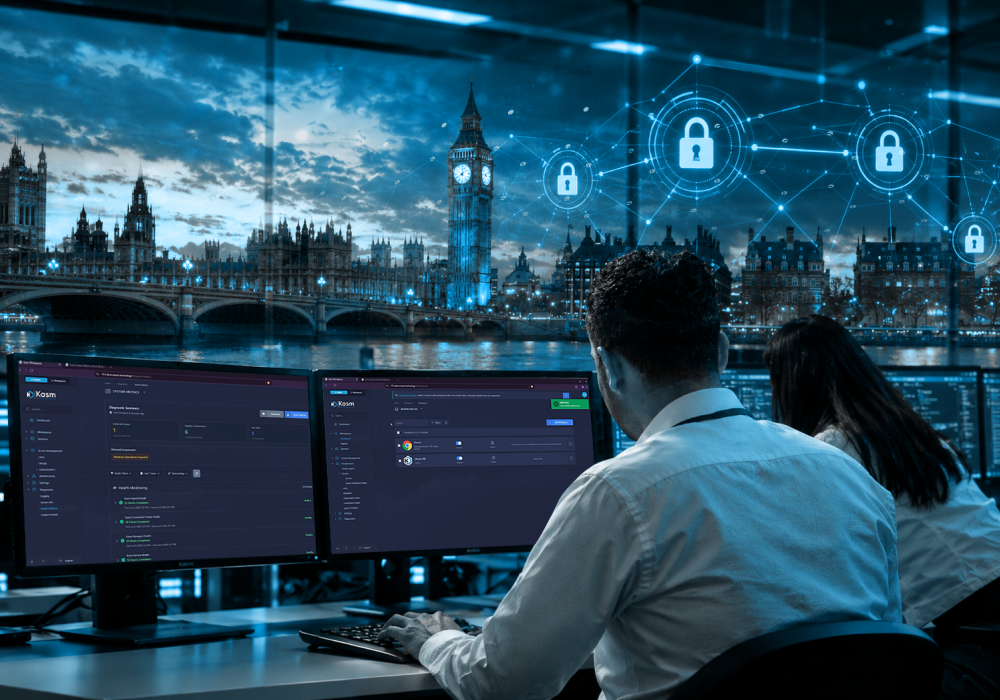
With Kasm Workspaces, an analyst can access a containerised browser or desktop that is streamed to the device rather than installed locally. The workspace exists for the task and is destroyed when the session ends.
That creates a clear boundary between the investigator's device and the activity taking place inside the session. Routing can also be handled through technologies such as OpenZiti or Dispersive, helping separate investigative traffic from force infrastructure.
The objective is not simply to hide an investigator. It is to make the investigative environment controlled, temporary and easier to govern.
The AI Question Is Already Arriving
The same architectural question is becoming more important as policing adopts AI.
On 10 June 2026, the College of Policing and Home Office launched PoliceAI, backed by £75 million over three years and operating across the 43 forces in England and Wales. Its AI Lab is assessing commercial and open-source models and providing a sandbox for testing them with data before operational deployment.
The challenge is therefore no longer simply which AI model to use. It is where those model runs, what data it can access and what happens when the session ends.
PoliceAI is building an assurance layer around multiple models. Its CoPA assistant, for example, uses a self-contained deployment within a secure police service Azure tenant.
Kasm Technologies is not part of the PoliceAI programme, but the architectural question is similar. A private language model could run within the same containerised environment as an analyst's work, using CPU or an allocated share of GPU resources and remaining inside the session boundary.
When the session ends, the workspace and its working data can end with it.
Containment as the Common Thread
Online investigation and AI may appear to be separate challenges. Architecturally, they share a common problem: how do you give people access to powerful capabilities without allowing that activity to become an uncontrolled extension of the organization's infrastructure?
Disposable digital enclaves offer one answer.
The investigation does not have to live on the investigator's device. The AI model does not have to become another permanent platform to govern. Both can operate within controlled, temporary environments designed around the task.
The most important record may always be the one an investigator never intended to create: four visits, one pattern, and a log entry somewhere else.
The architecture surrounding the work determines what happens next.
Explore the Workspace Approach
Forces looking to contain online investigations and the AI workloads that will follow can explore how Kasm Workspaces delivers browsers, desktops and applications through ephemeral, policy-controlled sessions.
Learn more about Kasm Workspaces and secure workspace delivery.
Want to see the approach in practice? Try Kasm Community Edition for free.