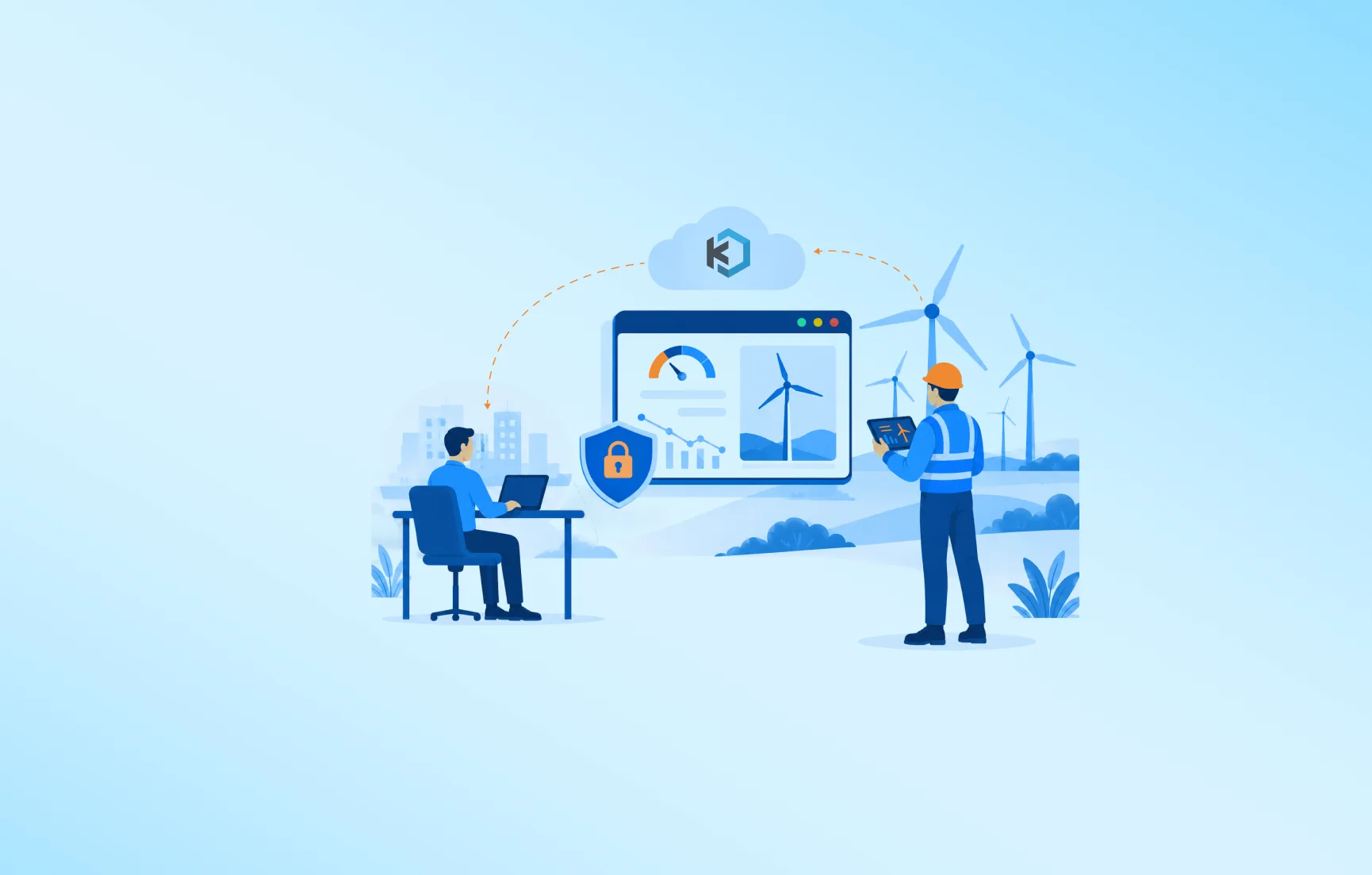
A renewable energy operator runs wind farms across multiple regions. Keeping turbines generating depends on field engineers and technicians who need remote access to wind farm and turbine control systems - operational technology tied to physical infrastructure, where uptime and safety matter and access has to be tightly controlled without slowing anyone down in the field. That access now runs on Kasm Workspaces, delivered through a regional channel partner.
OT access on an IT-era VDI
Before Kasm, technicians reached control systems through a Citrix VDI deployment. For a conventional office workload that is a familiar pattern. For an OT workforce it created specific problems.
The population is large but the usage is not: roughly 3,000 named technicians, of whom 600-1,200 are connected at any one time, most needing short, task-based sessions into a control system rather than a persistent desktop. Per-seat VDI priced and provisioned for the former. Remote, multi-region technicians connected back to centralized VDI infrastructure, and the latency showed - a direct problem when the session is interacting with a live turbine.
WHERE THE INCUMBENT FELL SHORT
 High cost and operational complexity for a workforce of roughly 3,000 named technicians (600-1,200 concurrent), most of whom only need short, task-based sessions into control systems rather than persistent desktops.
- Latency and performance issues for remote, multi-region technicians connecting back to centralized VDI infrastructure, which is a direct problem when the session is being used to interact with live turbine systems.
- No native autoscaling or SSO passthrough, making it harder to flex capacity to field demand or enforce consistent identity controls across a distributed OT workforce.
- Regional data compliance requirements that a VDI footprint tied to specific data centers struggled to meet across EU and US deployment regions.
When the session is controlling a turbine, latency and exposure are operational risks, not inconveniences.
Why Kasm: an architecture that matches how OT access is used
Kasm Workspaces replaced the VDI model with browser-based, containerized access. The proof of concept compared it directly against Citrix on bandwidth cost, overall cost and user experience, and demonstrated lower latency for remote, browser-based access to the control environment. The strongest validation points were architectural; lower overall cost followed from them.
Browser-isolated sessions
Technicians reach turbine and wind farm control interfaces through an isolated, disposable container session in the browser rather than a persistent remote desktop or a direct network path from an endpoint into the OT network. That narrows the attack surface for infrastructure that cannot tolerate casual exposure, and works from managed or unmanaged devices.
Licensing shaped like the workforce
Concurrent-session licensing, scoped at 300 concurrent sessions, matched real usage far more efficiently than per-seat VDI. Autoscaling lets session capacity rise and fall with real-time technician demand instead of being sized for peak at all times, reducing cost and improving resource efficiency.
Multi-region, with identity built in
Kasm runs self-hosted on Azure across EU and US regions, which addressed the regional data-sovereignty requirements the Citrix footprint had struggled with. SSO passthrough enforces centralized identity control across the distributed workforce - called out as a specific differentiator versus the prior approach.
The open question, handled
One technical item was still open when the initial scope closed: whether Kasm’s graphics performance matches Citrix HDX 3D for the subset of engineering users on 3D-intensive workloads. The scope allows a mixed deployment - Kasm for the general technician population, Citrix retained for 3D-dependent engineering seats, with a documented path to consolidate those seats once performance is formally validated.
OT as the anchor, IT as the expansion
Although the driving use case was OT access, the same deployment was scoped to serve the operator’s standard corporate office applications rather than standing up a separate tool for office workers.
- One platform, two environments. The same concurrent-license pool and container-streaming architecture serves technicians reaching control systems and office users reaching corporate applications.
- Shared security model. Browser isolation and SSO passthrough apply uniformly to both populations, while workspaces are provisioned to user groups based on what each needs.
- Room to expand. The engagement was scoped to extend beyond the first 400 users into additional use cases, including the remaining Citrix-dependent engineering workloads once 3D performance is validated.
Once Kasm is proven for the harder, more sensitive OT problem, extending it to lower-stakes office access is a comparatively easy next step on the same architecture.
Outcome
The engagement closed with 300 concurrent Kasm Workspaces Essentials licenses with Standard Support, self-hosted and deployed across EU and US regions. Technicians have secure, browser-based access to wind farm control systems on managed or unmanaged devices in place of the prior Citrix VDI approach, with standard office application access layered onto the same platform and a documented path to bring remaining engineering workloads over.
Results
| Metric | Before | With | Impact |
|---|---|---|---|
 Access model | Persistent Citrix VDI desktops into the OT network | Disposable, browser-isolated container sessions | Narrower OT attack surface |
 Latency to live control systems | Remote technicians routed to centralized VDI | Regional EU and US deployments on Azure | Lower latency, validated in POC |
 Licensing | Per-seat VDI for ~3,000 named technicians | 300 concurrent sessions with autoscaling | Cost matched to real usage |
 Capacity | Sized for peak load at all times | Scales with real-time field demand | Lower cost, better resource efficiency |
 Identity control | No SSO passthrough across regions | SSO passthrough for OT and IT users | One identity policy, enforced |
 Data sovereignty | Footprint tied to specific data centers | Self-hosted in EU and US regions | Regional compliance met |
| Platforms | Separate OT and IT remote-access stacks | One Kasm deployment for both | 2 environments → 1 platform |
Lessons for OT and critical-infrastructure teams
- Lead with architecture, not licensing. Latency, browser isolation and multi-region compliance carried this decision; cost followed.
- Concurrent-session licensing fits field workforces. A large named population with a much smaller concurrent footprint is the natural case for it.
- Settle 3D graphics parity early. If engineering users depend on HDX 3D, get an explicit answer rather than leaving it as an informal caveat.
- Position IT as the easy second step. A proven OT deployment typically needs little rework to extend to office access.